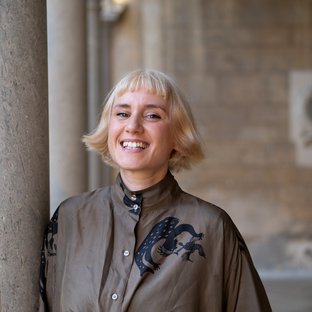
Dr Alexandra Hertlein
Biography
I joined St John’s in October 2026 as Career Development Research Fellow. I studied German literature, Classics, philosophy and history at the universities of Freiburg, Rome and Oxford (Staatsexamen, MSt). From 2019 to 2020 I was a Research Assistant in the Faculty of Classics at the University of Freiburg, before returning to Oxford to pursue a DPhil in Modern Languages at St Catherine’s College. Before coming to St John’s, I taught German as a Stipendiary Lecturer at St Peter’s and Hertford Colleges (2025–26).
Teaching
My teaching at Oxford spans German literature from the early modern period to the present, as well as translation from German into English. I currently teach Master’s courses on the Enlightenment and the Bildungsroman, and contribute to undergraduate teaching through lectures on German literature of the 1770s–1800 (Paper VIII) and Special Subject teaching (Paper XII).
Research Interests
My research asks how cultures imagine and (re-)construct their origins. I work on the German discourse of Ursprünglichkeit, a word that folds together primordiality, antiquity, originality and authenticity, and on how that overlap shaped what German writers could claim for their literature and their nation. My doctoral thesis examined why the question of origins became so urgent around 1800, when new ideas of geological Deep Time unsettled received chronologies and German writers sought a cultural genealogy independent of classical antiquity and French authority. The collecting of folk song was part of this story, and it shapes my interest in the history of world literature: by making songs from different places commensurable and comparable, Herder and other collectors influenced what came to be understood as ‘world’ and as ‘literature’, long before Goethe coined the term Weltliteratur. I also work on the reception of classical antiquity from the early modern period to modernism, with a particular interest in Nietzsche’s philological practice and his reception of antiquity.
My current project follows German cultural self-fashioning into the long nineteenth century. Germany came to imagine itself as a 'Kulturnation', a nation made by culture rather than political institutions, prizing inwardness (Innerlichkeit), spirit (Geist) and cultural autonomy. I trace the material practices and infrastructures that cultivated and sustained this ostensibly immaterial national identity, from monument culture to the railway, and the tensions between how a culture represents itself and the conditions of its production.
Recent publications
- ‘Dialect Publications and Concepts of “Germanness” around 1800’, in Concepts of Language in the Long Eighteenth Century: The German Discussion in the European Context, ed. by J. O. Jost-Fritz and Y. Mevissen (New York: Camden House), forthcoming.
- ‘Der Reichsapfel des Paris. Moraldidaktische Mythenkorrekturen des Parisurteils in der höfischen Festkultur des 17. Jahrhunderts’, in Schauspiele der Staatskunst. Politische Fiktionen des 17. und 18. Jahrhunderts zwischen Didaxe und Repräsentation [Germanisch-Romanische Monatsschrift], ed. by C. Meid/C. Schmitt-Maaß (Heidelberg: Winter, 2025) pp. 331–334.
- ‘Unoriginelle Originale. Nachahmung und die Ästhetik des Unverfälschten in Volksliededitionen des späten 18. Jahrhunderts’, in Unoriginelle Literatur um 1800. Nachahmung nach der Nachahmungspoetik, ed. by A. Hildebrandt and E. Thomalla (Zeitschrift für Germanistik) (Bern: Lang, 2024), pp. 121–150.
- ‘Bestiarium des Barbaren – Nietzsches Raub-, Sklaven- und Haustiere im Lichte der Antike’, in Nietzsche, das “Barbarische” und die “Rasse”, ed. by S. Kaufmann and M. Winkler (Berlin/Boston: De Gruyter, 2022), pp. 69–84.
- ‘“Am Eingangstor der hellenischen Ethik”: Nietzsche liest Hesiod’, in Nietzsche als Leser, ed. by H.-P. Anschütz et al. (Berlin/Boston: De Gruyter, 2021), pp. 111–129.