Sir Howard Colvin Lecture 2026
- Date 24 February 2026 - 5.00 p.m. - 24 February 2026 - 6.30 p.m.
- Location Garden Quad Auditorium, St John's College
The speaker:
Anthony Geraghty is Professor of the History of Art at the University of York. He is best known for his work on Sir Christopher Wren and the architecture of the English baroque, including a catalogue of the Wren drawings at All Souls College, Oxford (2007) and a history of Sheldonian Theatre, Oxford (2013). His most recent book is a study of the Empress Eugénie in England (2022).
The lecture:
Professor Geraghty's lecture will revisit one of the great moments in British architectural history – the emergence of the English baroque style in the years around 1700. It will look afresh at the principal architects involved – Christopher Wren, Nicholas Hawksmoor, and John Vanbrugh – and it will offer new interpretations of their haunting, compelling designs. More specifically, the lecture will show how each of these architects grounded their work in a distinctive set of philosophical first principles, and how it was the coming together of these discrete artistic personalities that brought the English baroque into being. The lecture will thereby revisit two of the main research areas associated with Sir Howard Colvin: the centrality of the Office of Works in the history of British architecture, and the place of biographical analysis within the discipline of architectural history.
Registration:
This lecture is open to all, but we ask that all attendees please register in advance using the link provided below.
Register here.
Sir Howard Colvin:
Howard Colvin (1919–2007) was elected a Fellow of St John’s in 1947 and served as the College’s medieval history tutor for four decades. A graduate of University College London, Colvin was the first St John's Fellow not to have been educated at Oxford. Nonetheless, he quickly ‘found the college [to be] a highly congenial society […] and an excellent place for the pursuit of scholarship, whether medieval or architectural’, and it was here at St John’s that Colvin produced – and repeatedly revised – the landmark works that established him as the doyen of English architectural history.
Between 1951 and 1982, Colvin was the General Editor of a colossal six-volume History of the King’s Works, chronicling all royal building activities from Saxon times until the mid-nineteenth century. Colvin wrote much of the pre-nineteenth-century material himself and edited what remained to an exacting standard. Meanwhile, in 1954, Colvin published the first edition of his Biographical Dictionary of British Architects: a project he had first conceived as an undergraduate and which would change the face of architectural history. By applying the methods and evidential standards of medieval historical scholarship in his Dictionary, Colvin rescued architectural history from amateur antiquarian speculation and curbed what he called ‘irresponsible attributionism’. In doing so, Colvin established architectural history as a serious academic discipline. In 1965, the University appointed Colvin Reader in architectural history. Although he was never made a professor, he took pride in being the ‘first and only don in Oxford officially to teach architectural history’ – creating a popular special subject on that topic and supervising various graduate students who would go on to be leading practitioners in the field.
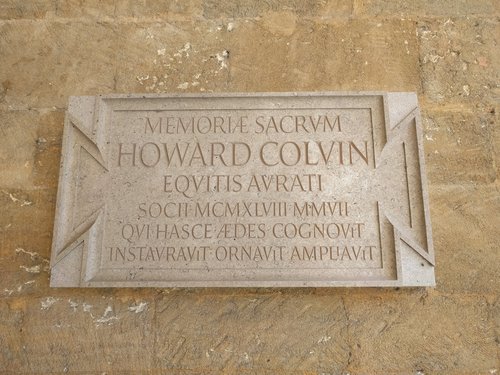
Beyond his scholarly endeavours, the College owes Colvin an enormous debt for keeping a discerning eye on its architectural fabric. In the 1950s, Colvin played a decisive role in commissioning the Architects’ Co-Partnership to build the Beehive – the first modernist addition to an Oxford college. Later in his life, Colvin also personally designed an addition to the Senior Common Room. As Fellow Librarian, Colvin was instrumental in converting the residential rooms beneath the Old Library into a much-needed new reading room (known as the Paddy Room, since converted to tutorial rooms in 2024). He also published a significant study of the architecture of Canterbury Quad. It is fitting that a plaque in Colvin’s memory now stands in that most celebrated of Oxford quadrangles.