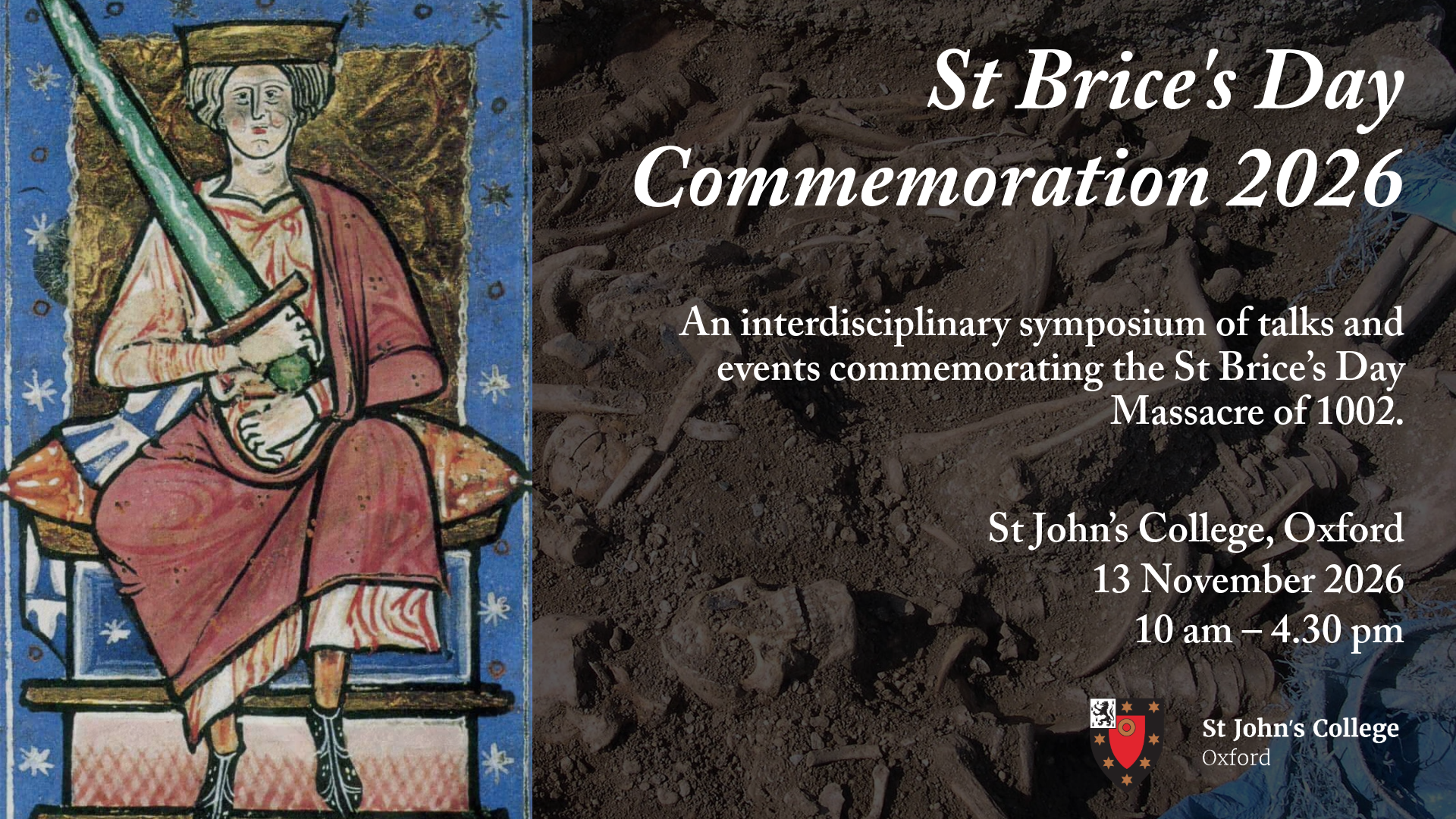
St Brice's Day Commemorations 2026
- Date 13 November 2026 - 10.00 a.m. - 13 November 2026 - 4.30 p.m.
- Location St John's College
On 13 November 1002, King Æthelred II of England ordered the massacre of Danes living in England, fearing that they meant to kill him and his advisers and take over the kingdom. In Oxford, Danes sought sanctuary in St Frideswide's Church, which was set upon and burnt down by their pursuers.
The remains of at least thirty-five men and boys likely killed during the massacre were discovered in central Oxford in 2008, when St John's College was preparing to build its Kendrew Quadrangle. Since then, the College has marked St Brice's Day with various public-facing talks and events that have reflected on the Oxford massacre and eleventh-century England and Europe.
We look forward to welcoming visitors for our St Brice's Day commemorations on Friday 13 November 2026, where leading researchers will share their insight into Oxford's Viking past and what we can learn today from this violent local history.
The full programme is available below and on Eventbrite, where you can register to attend. All events are free, but advance registration is essential. Lunch and refreshments will be provided free of charge.
Join us in the Garden Quad Reception Room for refreshments and biscuits before the talks and events begin.
Following refreshments in the Garden Quad Reception Room (from 10.00 am), the College President, Professor Lady Sue Black, will welcome guests and explain the significance of St Brice's Day at St John's.
A comparison between England’s Vikings and France’s Vikings and the different current attitudes to their legacy.
Lesley Abrams is Emeritus Fellow of Balliol College, Emeritus Professor of Early Medieval History, and Honorary Research Fellow at the Department of Anglo-Saxon, Norse and Celtic in Cambridge.
Her research focuses on Scandinavians outside their homelands in the Viking Age, taking an interdisciplinary and comparative approach to investigation of how fighters, traders, and settlers across the Scandinavian diaspora interacted and integrated with host societies.
An exploration of the turbulent reign of Æthelred II, revealing how Viking raids, Danish settlement and Anglo-Danish relations helped shape the history of England at the turn of the first millennium.
Professor David Griffiths is Professor of Archaeology and a Fellow of Kellogg College, Oxford University, and a Visiting Professor at UHI, the University of the Highlands and Islands. He has researched, excavated and published Viking sites in England, Wales, Norway and Orkney and has written extensively on the Viking Age.
Lunch in the Garden Quad Reception Room, accompanied by a viewing of archaeological posters.
Where does Old Norse survive in the present day? This talk will look at place-names, legendary traces and the surprising legacy of Norse words in the English language.
Carolyne Larrington is an Emeritus Research Fellow at St John’s College and is the former Professor of Medieval European Literature at Oxford University. She specialises in Norse mythology, medieval literature, Arthurian legends, and folklore. She has translated The Poetic Edda and written many books including The Norse Myths. Her research explores ancient storytelling and its influence on modern culture, including Game of Thrones, fantasy literature, and popular media today.
This talk will introduce the types of poetry that Scandinavians in England composed and would have known, including poetry about the experience of battle. It will situate this poetry alongside Old English poems that narrate encounters between the English and the Vikings.
Professor Gareth Lloyd Evans is Associate Professor of Old Norse at Oxford University and a Fellow of St John’s College. He specialises in Viking Age literature, Icelandic sagas, mythology, and medieval Scandinavian culture. His research explores gender, masculinity, identity, and emotion in Norse society. Author of Men and Masculinities in the Sagas of Icelanders, he currently investigates transgender and gender-fluid identities in the Viking world.
Dr Mark Atherton teaches Medieval English literature and English language at Regent's Park College, Oxford, and at Mansfield College. He is author of a monograph The Making of England: A New History of the Anglo-Saxon World and more recently a study of an Anglo-Saxon poem The Battle of Maldon: War and Peace in Tenth-Century England. For fans of the Teach Yourself series of textbooks he has written Complete Old English, which offers a contextual, jargon-free introduction to the language of the period.
Mark will explore how the events of St Brice's day and related events were reported in the Old English (i.e. Anglo-Saxon) documents. He will also perform 'The South Gate', a song inspired by the events of St Brice's Day.
In his spare time he writes, sings and plays in a folk band 'Mark Atherton and Friends', many of the songs in fact being inspired by the texts and poems he teaches for the English syllabus. The song he will be performing with members of the band is inspired by research on the literature and documents written during the reign of King Æthelred the Unready. In the style of a short ballad, it evokes the atmosphere of the period, the events of St Brice's Day and the attack on Oxford in the year 1009.
Professor Lady Sue Black, President of St John’s, reflects on how the events of 1002 still resonate today and what we can learn from this remarkable episode in our shared history Drawing on her expertise in forensic anthropology, Professor Lady Sue Black explores how science can bring the past to life, revealing new insights into the people, events and communities of Viking Age England.
A commemorative event in the St John's College Chapel.