2026 Founder’s Lecture: Becoming a Reader
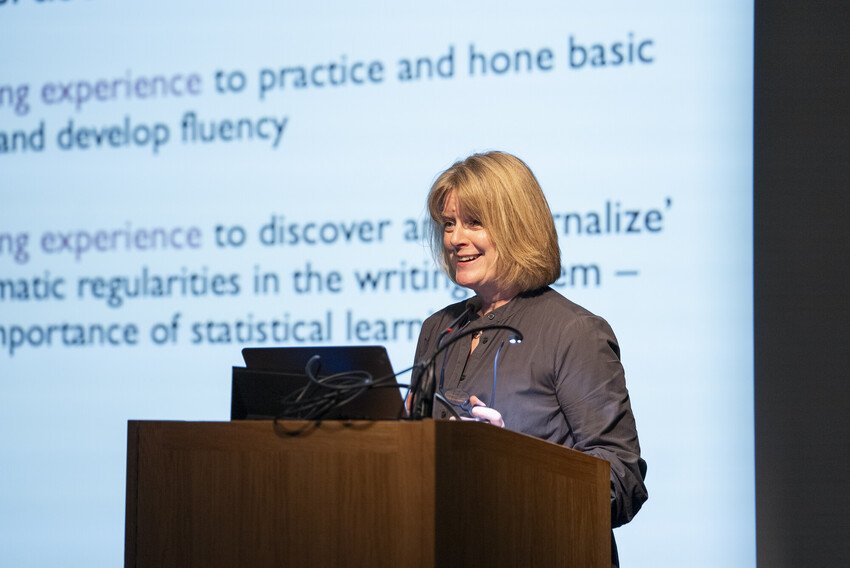
Learning to read is transformative. Literacy is the basis for acquiring basic knowledge, cultural engagement, and success in the classroom as well as the workplace. Yet, as Professor Nation’s lecture began by stating, reading is a difficult and unnatural skill that typically requires years of instruction and practice. The scale of the challenge posed in becoming a reader – in which we go from mapping letters to sounds to efficiently processing complex texts – is easily forgotten once surmounted.
Having emphasised the challenge of becoming a reader, Professor Nation set out the first steps in reading development. For alphabetic languages such as English, novice readers must learn that the letters of the alphabet (graphemes) work together in systematic ways to represent the sounds of language (phonemes). In order to comprehend this ‘alphabetic principle’, she argued, direct and systematic phonics instruction is essential.* Acquiring even a rudimentary understanding of grapheme–phoneme relationships allows novice readers to decode many unfamiliar words within their language, preventing them from memorising thousands of individual words.
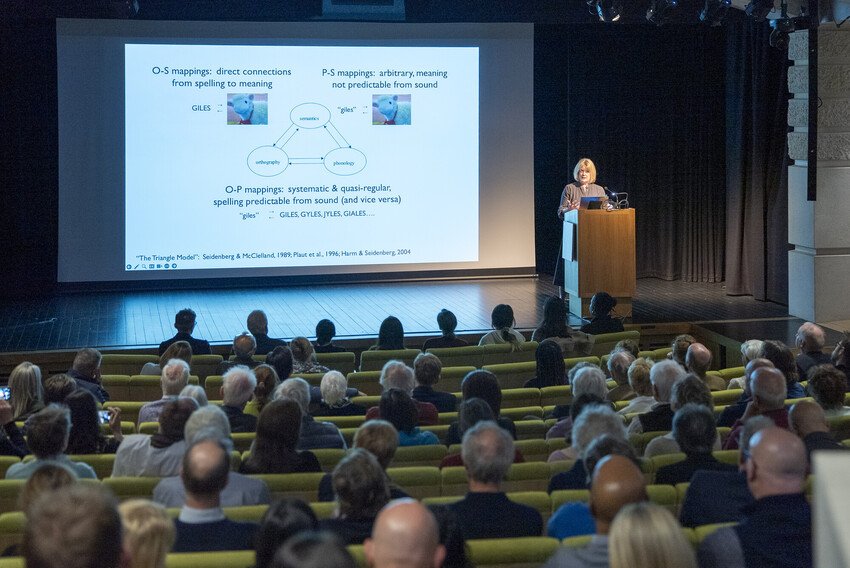
Whilst Professor Nation presented clear evidence that phonics instruction is important, she stressed that it is not sufficient as a route to reading expertise. Effective phonics instruction must take place within a wider programme of language experience. Alongside using ‘decodable’ books to crack the alphabetic code, novice readers also benefit from having more complex literary works read to them.
Practicing any new skill, whether reading books or riding a bike, is essential to developing expertise. Professor Nation argued that as budding readers practice their new skill they not only begin to recognise words more quickly and efficiently, but they also start to implicitly understand the probabilistic nature of written language. Through copious experience, budding readers gradually accrue a personal database of the predictable rules and structures that govern meaning at both word and sentence level, allowing them to engage with increasingly nuanced and challenging texts.
In the latter part of her lecture, Professor Nation explored the important distinction between spoken language and written language. Spoken communication relies on intonation, facial expression and gesture to convey meaning. To compensate for its lack of visual and auditory cues, written language is necessarily more precise, lexically rich, and syntactically complex than spoken language. Acquiring literacy and being exposed to the unique complexity of what she called ‘book language’, Professor Nation argued, equips readers with the necessary skills for further development. In formal education, for instance, learning about complex ideas or problems is predicated on being able to first digest the written language in which those ideas and problems are expressed.
This discussion of book language gave rise to a reflection on the cultural implications of the UK’s literacy crisis. As reading competes with new technologies and digital media, in which oral communication and short-form video is dominant over written language, people may encounter fewer opportunities to engage intellectually with the complexity of written language. Professor Nation suggested that this cognitive offloading may ultimately limit our ability to reflect critically and imaginatively about complex problems and issues.
In concluding the lecture, Professor Nation discussed the relationship between reading and empathy. As she reported, book language is ripe with emotionally arousing language and nuanced representations of mental states in ways that conversational language is not, leading some to suggest that reading can strengthen our ability to comprehend other people’s mental states. While acknowledging that the causal connection between reading and empathy is limited, Professor Nation argued that fiction nevertheless exposes readers to aspects of language and produces forms of social knowledge that may support the development of empathy.
The themes of Professor Nation’s lecture were particularly apt during this National Year of Reading. This is a national campaign led by the Department for Education and the National Literacy Trust which aims to tackle declining literacy rates and reading enjoyment across the UK, particularly among young children. Today, around a quarter of 11-year-olds are not meeting expected targets in reading and writing, while fewer than one in five children now read for pleasure every day.
Against the backdrop of such worrying statistics, Professor Nation’s lecture not only explained the linguistic and cognitive drivers of literacy, but also highlighted how essential literacy remains for accessing information about ourselves and the world around us. Becoming a reader is undoubtedly challenging, but it is a skill that we must do better to understand, teach, and encourage.
*The lecture touched briefly on the pedagogical and political battles surrounding phonics instruction. Those interested in the so-called ‘reading wars’ should consult the following article: A. Castles, K. Rastle, K. Nation, ‘Ending the Reading Wars: Reading Acquisition From Novice to Expert’, Psychological Science in the Public Interest, 19 (2018): 5–51.
The annual Founder’s Lecture was created in 2005 as part of St John’s 450th anniversary celebrations. The purpose of the lecture is to explore and discuss the principles and ideas that underlie any aspects of higher education and the modern world. You can watch Professor Nation's lecture, along with previous years, on our YouTube channel.