St John’s chemists develop more stable nanocrystal light sources
Reducing the size of crystals down to the nanometre scale – 10,000 times smaller than a strand of hair – opens up fascinating opportunities. These include making solids behave like atoms. Such ‘artificial atoms’ are highly desired for making the next generation of television displays that show a wider range of colours, as well as future light sources for quantum computing.
But with such a small size, the stability of these nanocrystals becomes a critical limitation. Over time, nanocrystals can agglomerate together, causing the efficiency of light emission to decrease, and also change the colour at which they emit.
The group of Professor Robert Hoye, tutor in Inorganic Chemistry at St John’s, have found a way to address this stability limitation.
In the study of acids and bases, a core concept is the idea that chemical species can donate a pair of electrons to another chemical species, forming an adduct. They used this idea to identify a solvent molecule – acetonitrile – that can donate a pair of electrons to the surface of the nanocrystal, causing the molecule to bind to the surface. In doing so, the acetonitrile protects the surface from being attacked by oxygen or water, as well as help to prevent agglomeration, thus improving stability. These molecules also fill in spaces left by missing atoms on the surface, thus improving the efficiency of light emission.
This research was led by one of the postdoctoral researchers in Professor Hoye’s group – Dr Jason Ye, and was funded by a research grant from College.
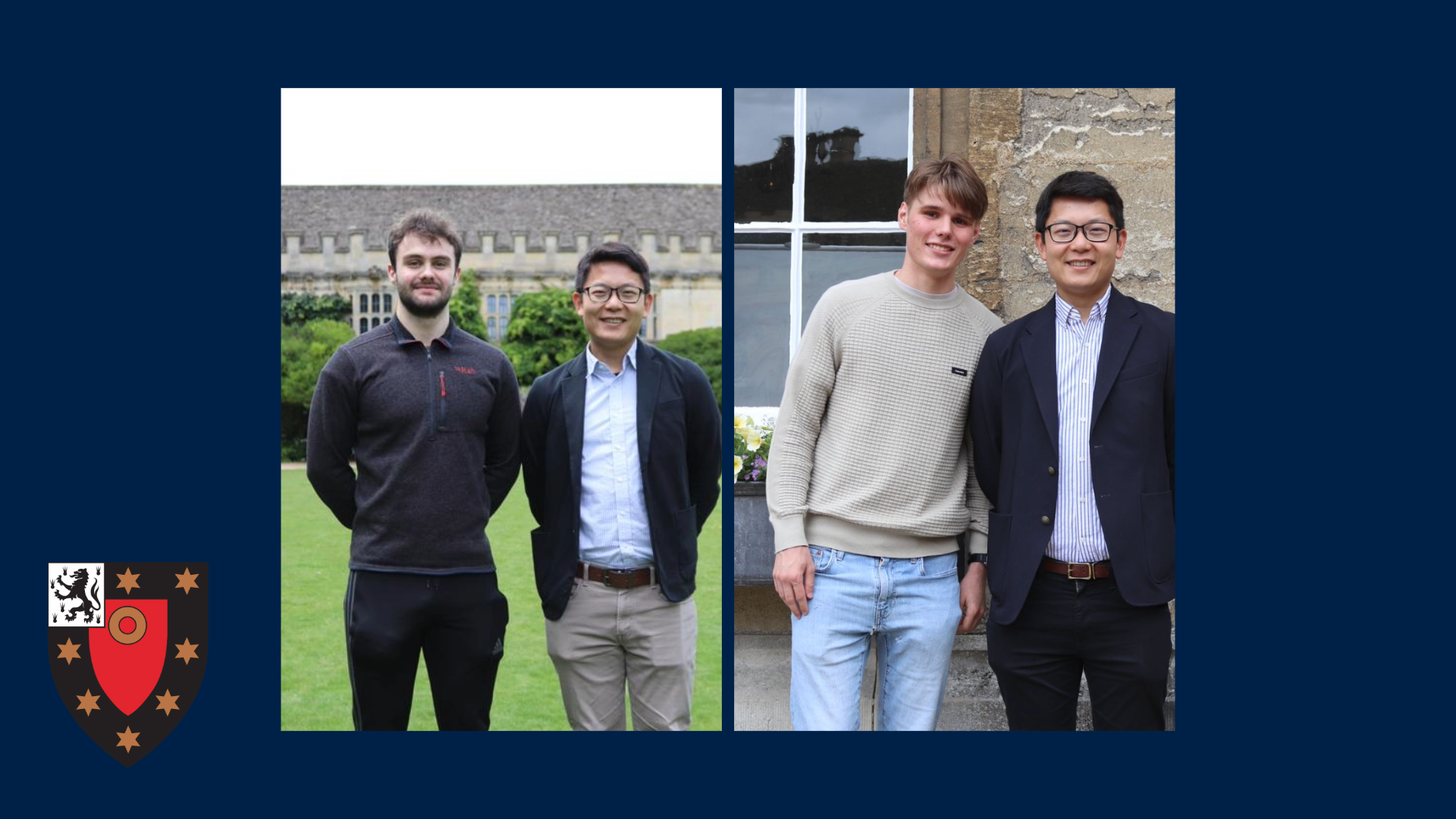 (left) Kieran De-Ville, standing with Robert after his internship; (right) Maxime standing with Robert in Front Quad.
Notably, this work also involved two Chemistry undergraduate students from St John’s – Kieran De-Ville and Maxime Atkinson. Both students worked on this project during the summer long vacation, emphasising the opportunities our undergraduates have to apply what they learn in the textbook to research. Kieran has now completed his undergraduate studies and is staying in Oxford to complete a DPhil.
This work has just been published in ACS Energy Letters:
J. Ye, C. Nicholls, et al., Stronger Lewis Base Antisolvents Improve Perovskite Nanocrystal Stability, ACS Energy Letters (2026). https://doi.org/10.1021/acsenergylett.6c00480