Tracing Extremism: St John’s Women’s Network Dinner with Dr Julia Ebner
This year’s keynote speaker was Dr Julia Ebner (2019, DPhil Anthropology), one of the leading voices in the study of radicalisation. Her talk, entitled ‘Tracing Extremism: New Trends and Old Patterns of Radicalisation,’ offered a timely and insightful glimpse into how movements are evolving in an era defined by cultural polarisation and social fragmentation.
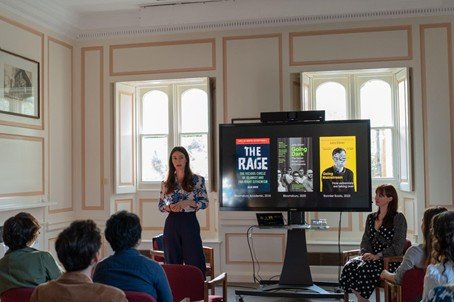
The evening began in the Canterbury Quad in the New Seminar Room, where Rose Sundt (2015, Japanese), Women’s Network Steering Group member, welcomed guests and introduced Dr Ebner, whose work has informed international policy, her books — ‘The Rage: The Vicious Circle of Islamist and Far-Right Extremism’, ‘Going Dark: The Secret Social Lives of Extremists’, and ‘Going Mainstream: How Extremists Are Taking Over’ - are essential reading for those seeking to understand the psychology of modern extremism. Her work not only attempts to humanise and understand this trend, but also to help predict and prevent future radicalisation. In recognition of her impact, Julia was named Austrian of the Year 2024 by Die Presse and the Austrian Foreign Ministry, honouring her for international achievement and contribution to public understanding of extremism and disinformation.
Dr Ebner’s talk was a deeply relevant exploration of how radical ideas take root; and why they continue to flourish in new forms across digital and social landscapes. Drawing on her years of research, she offered first-hand accounts of her work infiltrating extremist groups across the ideological spectrum, from far-right networks and neo-Nazi communities to “Tradwife” influencers, to jihadist circles.
She described how online spaces — from mainstream social media platforms to encrypted forums and gaming channels — have evolved to become fertile ground for ideological recruitment, particularly among young people searching for identity and belonging. “Extremist movements have evolved,” she explained, “but the psychological needs they exploit remain remarkably consistent — the desire for significance, connection, and clarity in an uncertain world.”
Julia also discussed the rise of what she terms “salad-bar extremism” — a growing trend in which individuals mix and match elements from different ideologies rather than subscribing to one coherent doctrine. “We’re seeing more hybrid movements,” she noted, “where conspiracy thinking, anti-establishment sentiment, and identity politics overlap in unpredictable ways.”
One theme of the talk, particularly resonant for the Women’s Network audience, was the gendered dimension of radicalisation. Dr Ebner spoke about the specific narratives that extremist groups use to target women and the often-overlooked role women play both within and against radical movements. We are also seeing a broadening gender gap between the ideological and political leanings. Julia also outlined the ways in which internet subcultures, such as the 'Tradwife' community, romanticise hyper-traditional gender roles, and examined how these narratives intersect with broader reactionary movements.
However, she was also optimistic. “Empathy,” Julia argued, “is one of the most effective counter-forces to extremism. The more we humanise people, even those who hold dangerous views, the less room there is for ideologies to thrive.”
Following the keynote, there was a Q&A session that delved deeper into the issues raised including why some countries are more affected by others than extremism and Julia’s predictions for future trends.
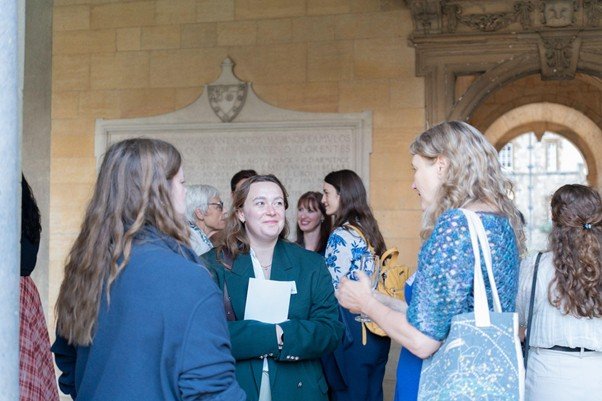
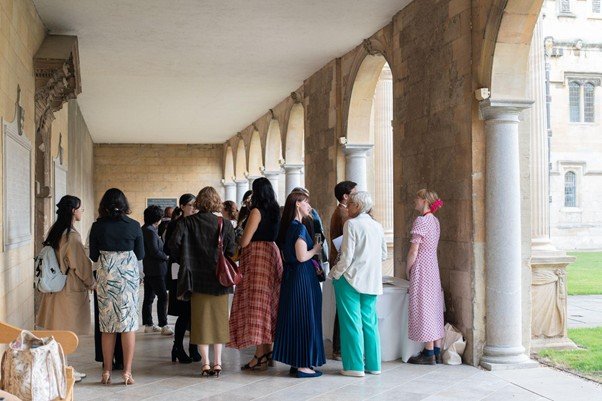
After the talk, guests enjoyed a drinks reception in Canterbury Quad, before gathering for dinner in Hall, where Kate Molesworth, Chair of the Network, welcomed those in attendance and began discussions that continued late into the evening. As guests left Hall, the prevailing feeling was one of inspiration and renewed connection; a reminder that understanding the darkest aspects of human behaviour can also illuminate the paths toward resilience and positive change.
We were honoured to have the event attended by both female presidents, Maggie Snowling and Sue Black. The atmosphere was one of warmth, curiosity, and shared purpose, a testament to the spirit of the Women’s Network, which continues to connect John’s women across generations, disciplines, and continents.
The network extends our thanks to Julia for her insight and generosity, and to the many students, alumni and staff at college whose ongoing support makes the Women’s Network such a vibrant and inspiring community.