Exhibition: The Austens at Oxford Overview
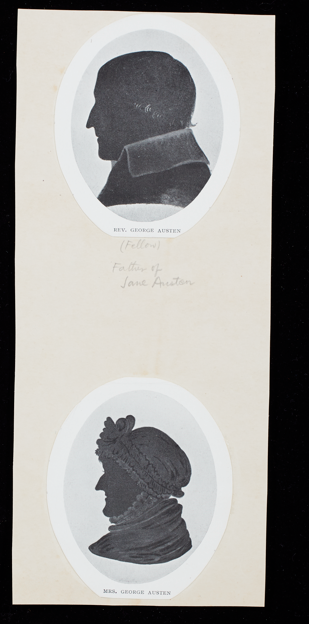
Jane Austen’s education at Oxford was short. She spent just six months at the age of seven at a school run by a relative, the widow of the principal of Brasenose. But other members of her family spent much more time in Oxford. Most significantly at St John’s where her father, George, and her brothers, James and Henry, were all fellows.
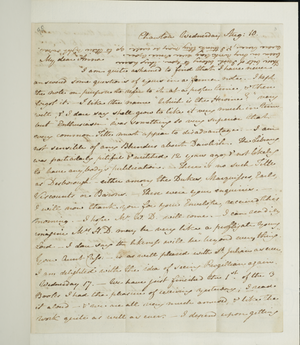
This was the basis for an exhibition in the College which was held in December, marking the 250th anniversary of Jane’s birth. The exhibition focused on Jane’s connections with Oxford, especially St John’s. It featured items from the Archive, copies of The Loiterer, a satirical periodical published by Jane’s brothers James and Henry when they were at St John’s, and which may – possibly! – include the first published writing by Jane herself. Pride of place was given to a book of Jane’s own letters to her niece, which has been in the College’s custody since 1939. The exhibition was open only for six days, but was visited by more than 900 people!
The Austen family’s connection with St John’s began in 1746, when the College living of Charlbury became vacant. As was custom the position of vicar was offered in turn to members of the fellowship, and James Luck decided to accept it. But the luck, here, was all George Austen’s. According to the College’s statutes, written by the Founder, Sir Thomas White almost two hundred years earlier, one of the fifty fellowships of St. John’s was to be reserved for a pupil at Tonbridge School. James Luck had been the Tonbridge fellow since 1720 and his resignation came at just the right time for young George Austen who was then top of the school.
George arrived in Oxford in the summer of 1747, aged just sixteen, and a fellow of St John’s College! Until the statutes were rewritten by the Victorians, St. John’s was unusual in its fellowship. There were 50 fellows, most from certain schools: 37 from the Merchant Taylors’ School, two each from schools in Reading, Coventry and Bristol, and one from Tonbridge. The remaining six were reserved for Founder’s Kin, that is men who could demonstrate that they were descended from one of Sir Thomas White’s grandfathers. They were all fellows from the minute they set foot in St John’s, even though they were undergraduates for their first three years.
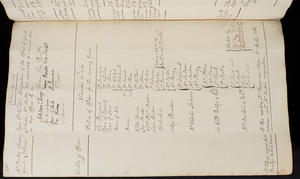
The College was a very different place in 1747 to now. Today we are used to the idea that the fellows are the tutors, teaching undergraduate and graduate students. However, until the late nineteenth century, the main purpose of the College was the education of the fellows, though the older fellows were also required to teach the younger ones, as well as commoners, who were undergraduates paying for their education. Although a few fellows studied Civil Law, most were expected to study theology and be ordained in the Church of England; indeed, if a fellow was not ordained within eleven years of entering the College, they would be expelled. It was normal for them to take the BA and then the MA, followed by the Bachelor and then Doctor of Divinity (BD and DD). To work through all four degrees, usually took 21 years, hence why the fellows needed the Founder’s charity. Most commoners stayed only a few years to take the BA.
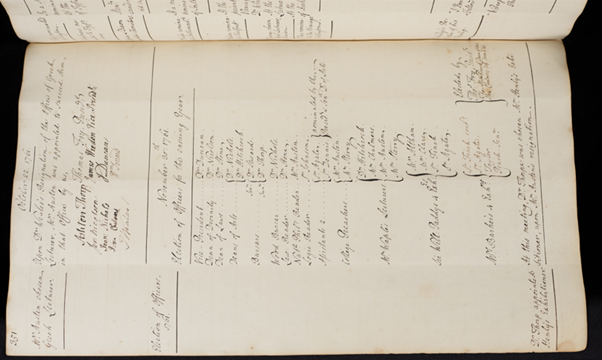
George spent 17 years as a fellow, and took the BA, MA and BD. While doing so he also taught Logic, Greek and Natural Philosophy (i.e. science) in College and was one of the University proctors. He was ordained deacon in 1754 and then priest in. But in 1764 George would turn 34 and his thoughts were turning to marriage. All the fellows, with the exception of the president, were required to be unmarried, and many of them resigned to get married. George married Cassandra Leigh, whose uncle was the Master of Balliol. But, perhaps more importantly, her brother James had been a student at St John’s from 1751 to 1758, studying Civil Law. He was a few years younger than George, but a BCL took seven years of study, and so James remained in College longer than the typical commoner, and perhaps the two young men became friends.
George’s marriage to Cassandra removed him from St. John’s, but it virtually guaranteed that his descendants would continue to be members of the College. Because Cassandra Leigh was the great great great great great granddaughter of Mary Bridgman, the sister of Sir Thomas White. Her children, therefore, could attempt to claim Founder’s Kin fellowships. This, of course, was sadly not open to Jane, but it was an option for her brothers.
Two of them took the opportunity and, like their father, became fellows of St John’s. James, the eldest child, became a fellow in 1779, took his BA in 1783, MA in 1788, was ordained priest in 1789 and resigned in 1792 on marriage. Henry was elected fellow in 1788, and overlapped with his older brother for four years. Henry took his BA in 1792 and MA in 1796. He resigned his fellowship in 1796. He married the following year, but it seems likely that he resigned in his tenth year to avoid being ordained which the College statutes required of him. Ironically, he did get ordained a quarter of a century later. Neither of the brothers remained so long at St. John’s as their father, and so did not hold so many offices as George, but Henry did hold the teaching post in Logic that his father had held 40 years earlier.
In the case of all three Austens – George, James and Henry – St John’s did exactly what it was supposed to do at the time, and train three learned clerics of the Church of England. But it is ironic that it was their daughter and sister, denied the educational opportunities of her male relatives, who is still remembered and treasured for her writings today. Nevertheless, if it is true that George Austen met Cassandra Leigh through his college friendship with her brother, then perhaps St John’s can claim some credit for the very existence of Jane Austen!
Written by Michael Riordan
A link to the exhibition page can be found here.